Dear Dr Blake,
I've been studying your blog for a few weeks now. I'm so grateful that you take the time to do this!
So, I was hoping you could help me with my sesamoid gone bad situation. Here is my story:
A few years ago, I fell during yoga. My toe swelled up like crazy. I went to the dr, had an X-ray and was told it wasn't broken. It healed quickly-- I was walking fine within a week and just had occasional soreness in the ball of my foot for a few months. My toe, however, never quite regained full movement. But, all seemed good. I could work out and wear heals, so i was happy!
Fast forward to this past October. Id started running more and had felt just a little bit of pain. Then I got a Thai massage-- in which they stepped on my feet-- it was really intense. (the funny thing is i had just gotten back from a trip to Thailand and had lots of massages without issues! ) I knew she did something. A few days later, my toe swelled like crazy.
I went back to the dr and had another X-ray. They said no fracture and referred me to a podiatrist. He said it was broken in half, there was no hope of healing it, and the only thing to do was give me a cortisone shot.
Dr Blake's comment: No one can ever tell with complete accuracy if an injury has no hope in healing. My patients have been fooling me for years, healing sometimes very difficult fractures without surgery. In most cases, we should always give the body a fighting chance to heal. Cortisone in this situation could only mask the pain, and the injury get worse (with more damage being produced by the lack of pain). Cortisone also slows the normal activity of the bone forming cells that are needed to heal bone injuries. There are so many treatments for sesamoid fractures that may be tried in an attempt to heal without surgery. Most of these treatments including orthotics, taping, dancer's pads, shoes, etc can be used if surgery is necessary. And, you have already learned what works and does not work.
At my questioning, he ordered a MRI. When the MRI came back, that report found no fracture and suggested sesamoiditis. (which confused me-- if it was indeed "broken in half," how did that not show on an MRI!?) He said it was still fractured, dismissed my questions and gave me a boot, but I also fired him. (Seriously the worst Dr I've ever seen)
Dr Blake's comment: Here is where I will try not to insult my friends the radiologists, but podiatrists read these subtle foot injuries so much better in general. This is why I always want to see the actual films/CD, and not just the report. The game I play is to review all the films first, come to my conclusions, then review the report. The radiologists who read the films do read many more than I, but they always are not treating the painful foot. The responsibility of treating the foot can awaken a sense of what causes pain and what doesn't.
On the advice of a friend, I got an exogen machine on eBay-- i used it a bit, but then started to notice a slight bump on the side of my foot -- suspect a bone spur-- and wondered if the machine could be causing the bump. Can the exogen machine hurt my foot if it's no fractured? ( which I'm not certain of at this point.)
Dr Blake's comment: Never heard of a bone stimulator causing excessive bone formation. They do not work like that. Exogen sends a negative charge at a fracture which allows one side of the fracture to be negatively charged and the other side positively charged. This pulls the sides towards each other. This does not cause bone formation. If both sides are positive, which is what they have found in bones that do not heal, the two sides of the fracture will not be drawn together.
I'm currently waiting for a new referral to a different podiatrist. But, it's slow moving with my HMO. (and I'm not sure how helpful he'll be-- losing hope! )
Dr Blake's comment: Check out if you can see any of the podiatrists in San Diego that are members of the AAPSM, generally a great group. See the website at www.aapsm.org and check the membership list. You can send me a list of who you can see in your HMO and I will be happy to refer you, or at least have you call someone in San Diego I know that knows the docs on your list.
I've been in and out of my oh so lovely boot since November-- it will get better, then I have to get back in the boot.
I just got a copy of my MRI -- and am trying to read it by looking over your blog posts. Haha! Then I thought, maybe I should just email him to see if he is willing to check out the images!
Anyhow, thank you so much for reading this and for all your blog posts!
Sincerely,
Ann from San Diego
Ann, thanks for contacting me. I will be happy to look at the images. You can fed ex to Dr Rich Blake 900 Hyde Street San Francisco Ca 94109. Never heard of any problems like that with Exogen. Do not lose faith in podiatry for the next one may be great. When I had a severe life threatening problem 27 years ago, I got 10 opinions. The last one saved my life. Hang in there. Rich
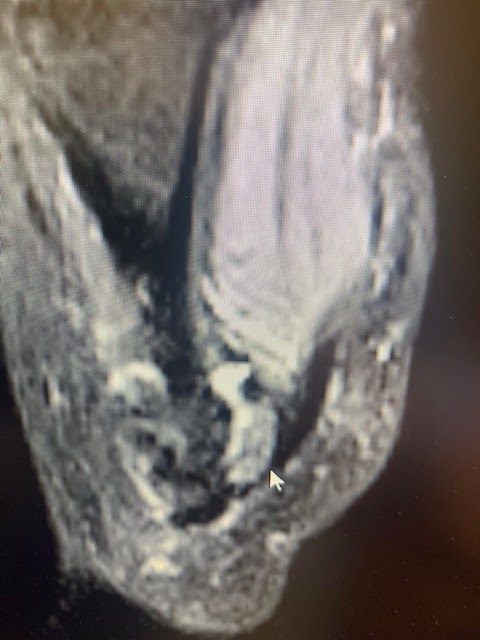
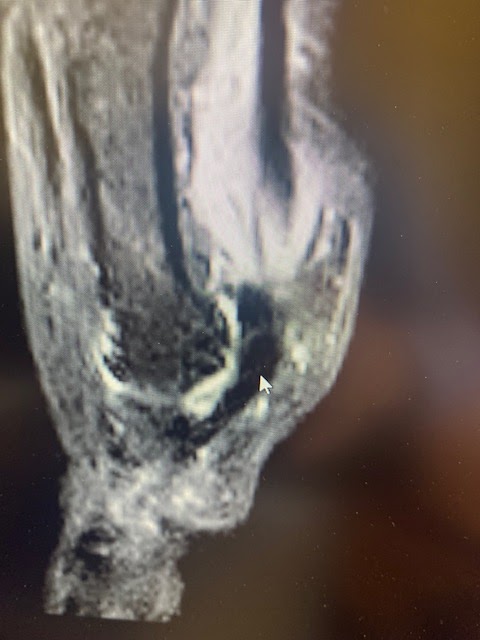
Then Ann sent the images below clearly showing that the tibial sesamoid bone under the first metatarsal was trying to heal. Quick recommendation: 2 months solid in the boot from this moment, find a new podiatrist who understands all the conservative treatments available, get a new MRI in 2 months to check progress, do not be out of the boot unless you are in shoes, inserts, taping, etc that produce a pain free environment for healing.
 |
| On this image the tibial sesamoid is dark when normal bone is white. Above the injured tibial sesamoid the first metatarsal looks very healthy, let us keep it that way. |
 |
| Same image except the normal bone is dark and bone trying to heal is full of fluid and is white. Note the swelling in the top and bottom of the big toe joint. This swelling produces significant pain and we need to gradually reduce. As you walk the sesamoid pushs on the swelling and produces pain. So right now you have pain from 2 sources. You need to eliminate the pain from the swelling by three times a daily cooling the joint down. 10 minute ice pack twice daily, and one full contrast bath treatment, normally is enough to accomplish this goal. |
 |
| This image of the area just below the metatarsal head dramatically demonstrates the pooling of swelling under the sesamoid. When you walk on the sesamoid, even after the sesamoid is healed, this swelling produces pain. Pain produces the terrible image that you are not getting better so when someone recommends surgery, it can be hard to resist out of frustration. |
 |
| Image section just above the last one showing that the swelling at the sesamoid level is all around the tibial sesamoid, and probably where the swelling seems to produce a bump.You may be developing a ganglion cyst in that area, but definitely not excessive bone formation from the Exogen machine. |
 |
| Another image now higher on the metatarsal 3mm or so above the sesamoid still showing swelling. When swelling gets into this part of the joint (closer to the arch), the bend of the joint may get restricted adding to the pain. |
 |
| This image is another 3mm higher than the last and clearly shows that the metatarsal head has no arthritis. Looks great. |
 |
| This type of image shows the good fibular sesamoid and the broken tibial sesamoid. The fracture line is only seen by inference at the junction of one part of the fracture to the other. This is quite common to see one part of the 2 fracture pieces looking more involved with the healing process. The arrow is pointing to the damaged tibial sesamoid. |
 |
| Another image of the healthy metatarsal head. Very important to make sure that we are only dealing with sesamoid problem, and not also hallux rigidus/limitus. |
 |
| Clear view of the injured tibial sesamoid all in one piece (not displaced), and no darkest in the metatarsal head above which would indicate some cartilage breakdown. |
 |
| Small bone spur is noted on the top of the metatarsal. |
 |
| Another small irregularity noted at the base of the big toe. |
 |
| This is probably the main reason you hurt. The swelling under the metatarsal head that you need to reduce. You want your rehab to be based on pain from the sesamoid injury, not pain from the swelling that collects here during the healing process. From the looks of the sesamoid it is going to take 6 to 12 months to get totally better, but you should be running much earlier than that. |
 |
Here is swelling also seen at the top of the joint.
|