I just got invited to host a monthly blog post for podiatrists in a magazine entitled Podiatry Today. It is another good source of information for podiatrists and lay patients alike. Hope it is helpful.
Saturday, June 20, 2015
Big Toe Joint Pain: Podiatry Today Post


Correcting Children with Flatfeet with Orthotic Devices
Custom Made Orthotic Devices with
Blake Design Improves Arch Structure in Developing Children
·
39
Flat Foot Children studied by x-ray evaluation over 6 years old (average age
10.3, range 6 to 14 years old) for a 2 year period to see if the arch developed
with Blake Inverted Orthotic Design
·
Blake
Inverted Orthotic Design is recognized worldwide as providing the most medial
arch support
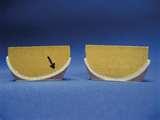
Orthotic
Device cross section standard heel cup (right) and Inverted Technique (left)
Orthotic
devices resting under Inverted molds (typically one foot more inverted than the
other
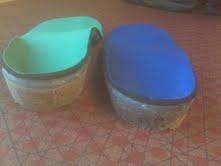
Standard
right arch and Inverted left arch
·
One
study showed that if children were to spontaneously reduce their flat feet (grow
out of it) it would be before 6 years old. Dr Ron Valmassy says it is
predictable at any age, but 8 years old is the gold standard of knowing if they
will grow out of it.
·
4
radiological angles (which measure arch collapse in the sagittal and transverse
planes) and one standing angle (measuring frontal plane) were measured at the
start of the study, 12-18 months into the study, and at 24 months.
·
Subjects
were required to wear orthotic devices for 8 hours per day minimal
·
Exact
Rx writing was used to individualize the custom orthotic devices based on the
RCSP (Resting Calcaneal Stance Position).
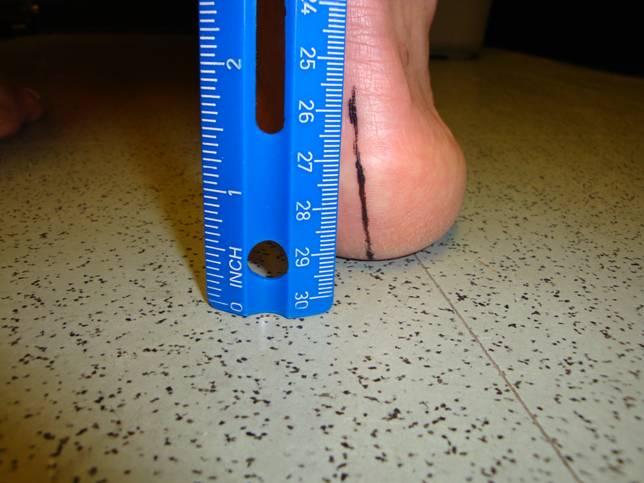
This
measurement, called the resting calcaneal stance position, changed from 8.0
everted to 1.9 everted with orthotic wear over the 2 years, and measures the
frontal or coronal plane component. The ideal is 0 degrees or heel vertical measured exactly with a goniometer.
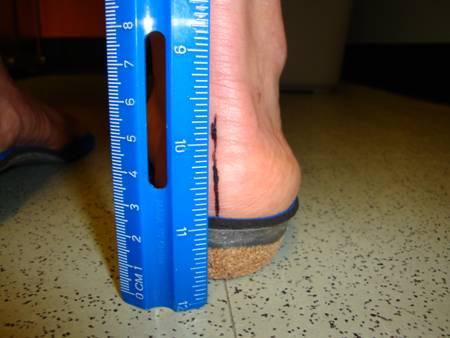
Here the exact angle is being measured with a goniometer.
Here the exact angle is being measured with a goniometer.
·
2
of the 5 angles showed significant improvement, 2 of the angles showed improvement,
and one was unchanged (the least predictive one generally)
·
Background
Info: Blake Inverted Orthotic developed here at Center for Sports Medicine
throughout the 1980’s. Dr Blake has lectured nationally and internationally
about the technique. At one point, 17% of all custom made orthotic devices in
Australia were this technique.
·
More
Background: Bias of Pediatricians and Orthopedic Surgeons is that all children
with flat feet will outgrow this, or at least there is no predictability in
selecting children for orthotic devices. Dr Ron Valmassy developed the criteria
in the late 1970s for predicting which children will not outgrow their flatfeet
and also has lectured extensively.
·
Flatfeet:
flexible and rigid. Flexible is the hardest to correct in adults and these were
the ones chosen for the study (typically more ligamentous laxity than a rigid
flatfoot). Flexible flat foot is much more common to see however in children,
and can develop into rigid flat feet after the age of 22 when the adult
ligament and bone structure is fully developed.
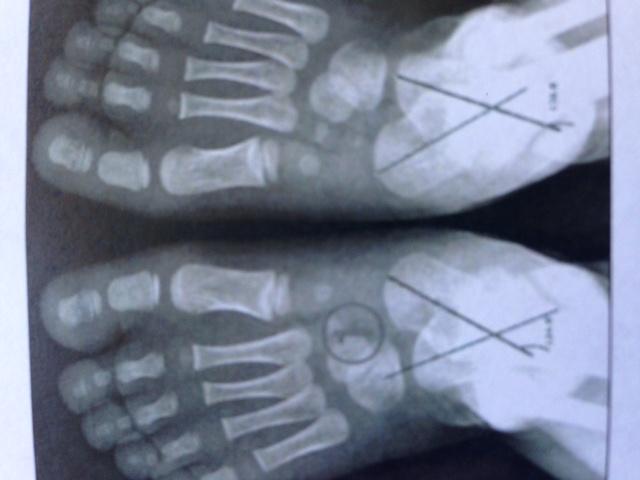
AP TCA is decreased as the arch gets better and the foot less splayed out
(Angle 1)
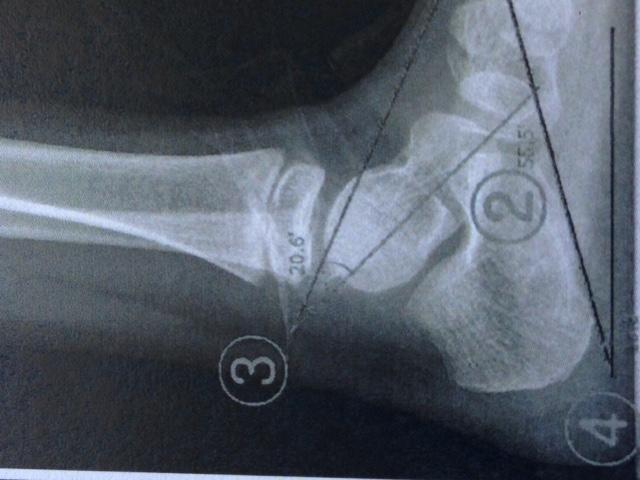
Lateral TCA should get less as the arch improves (Angle
2)
Lateral TMA should get less as the arch improves (Angle
3)
CP should get greater as the arch improves (Angle
4)
·
RCSP
changes 8.0 to 2.6 to 1.9 (less is good)
AP View TC Angle 38.4 to 38.1 to 29.6 (less is good) Angle 1 above
Lateral View TC Angle 47.3 to 49.8 to 47.3 (less is good) Angle 2 above
Lateral TM Angle 17.7 to 18.2 to 10.3 (less is good) Angle 3 above
CP Angle 11.6 to 14.7 to 16.0
(more is good) Angle 4 above
Dr Blake’s comments:
·
Article
used the Blake Design to customize the orthotic prescription typically not seen
in foot orthotic studies (allowing the 5 to 1 rule of cast correction to heel
eversion to create an equal and opposite force to control pronation)
·
The
calcaneus is the best guide since it can be accurately measured in the sagittal
and transverse planes (by the calcaneal pitch) and the frontal plane (by the
RCSP) since it is trapped against the ground. The talus is notoriously a poor
guide since it is influenced by the foot and ankle (and ankle positioning is
not standard with these x-rays).
Sunday, June 14, 2015
Running Shoe Lecture: Power Point Presentation
This is the second lecture I will give at our State Podiatry Meeting in several weeks. This again emphasizes the practical.
Saturday, June 13, 2015
Walking vs Running Mechanics: Lecture in PowerPoint
This power point presentation is for my State Meeting in several weeks. So, it is written for a podiatrist of various degrees of knowledge on the subject, and geared for practical advice.
https://drive.google.com/file/d/0BwmEZgwJ3YN7TUl4Tmx0RGlzX2c/view?usp=sharing
https://drive.google.com/file/d/0BwmEZgwJ3YN7TUl4Tmx0RGlzX2c/view?usp=sharing
Wednesday, June 3, 2015
OESH Shoes: Unique Shoe to Know About for Wide Forefeet
http://oeshshoes.com/
All of these OESH shoes are zero drop (no heel lift), and very straight lasted with wide forefeet). This is unique, and many patients may fit into when the forefoot width of standard shoes is too narrow.
All of these OESH shoes are zero drop (no heel lift), and very straight lasted with wide forefeet). This is unique, and many patients may fit into when the forefoot width of standard shoes is too narrow.
Tuesday, June 2, 2015
Help for bunions and hammertoes: Correct Toes
I have been looking for a product like Yoga Toes, that will be help to hammertoe and bunion patients, and that can be worn to walk in some shoes. One of my patients is wearing Correct Toes while walking in Keen (extra wide) athletic shoes. I hope it helps some of you. Rich


Monday, June 1, 2015
Arch Taping: Support the Foot Brand Excellent
The video above is a small introduction to a great taping technique for foot stability. So many foot problems are improved with taping, and this is one of the best new techniques I have seen in years. I first was introduced to the technique in July 2014. I have used the foot strapping in now 100 or so individuals with very good results. It runs about a dollar per day, and lasts 4 days or so. It survives showers and soaking, but not swimming pools. Go to their website. It is super easy to apply. I will try to make my own video soon. They sell in groups of 5, so you do not have to make too much of a committment before purchasing. Good Luck
Saturday, May 16, 2015
6PM.com place for athletic shoes discounted
http://www.6pm.com/
One of my patients told me that this was a wonderful place to get athletic shoes at a discount. Please check it out. It also has everything else, perhaps even the kitchen sink.
Foot Nerve Pain: You Tube Video Comment Reply
Hi Dr Blake, I have excruciating pain in between the 1st & 2nd metatarsal. (4 years ongoing). It only happens when I walk for long, try to run, carry heavy items or wear tight shoes. MRI scans showed nothing, XRays showed nothing. Could it be a neuroma? Massaging it helps alot. The cold also aggravates the pain. Anti inflammatory meds help as well as lyrica for nerves. My guess it is a pinched nerve or a neuroma.
Dr Blake's comment:
With the negative scan, this is typically an L4/L5 nerve root irriation or double crush syndrome. Neuromas are rare in this area. Look into neural flossing/gliding and topical NeuroEze. Have the nerves evaluated by a neurologist or physiatrist for radiculopathy. Definitely try to manipulate the weight bearing with Hapad Longitudinal Arch Pads and try restricting toe motion with toe separators, Budin Splints, spica taping. Ice Pack for 10 minutes twice daily for the next month to see if this is helpful. Hope this helps.
Saturday, May 9, 2015
Big Toe Joint Pain from Running: Email Advice
Hello Dr.,
I do not know if this email is still active, but I wonder if you could give me some advice. I am a 27 year old active male who, for the last 7-8 years has had big toe pain in my left foot. It seems to exacerbate on exercise and calm down when I rest it. It doesn't seem to be getting worse, although it does tend to be quite tender after running. I have no bone spurs that I can feel, and retain the same ROM as the other foot. I had x-Rays about 7 years ago when I noticed it and the podiatrist suggested the usual hard sole shoes and orthotics, which I didn't follow through with. Should I be treating this like a sore joint and avoiding exacerbating activities, or should I be looking into surgery? If it is the latter, which surgery might retain maximal functionality of the toe ultimately? I appreciate your time and your response.
I do not know if this email is still active, but I wonder if you could give me some advice. I am a 27 year old active male who, for the last 7-8 years has had big toe pain in my left foot. It seems to exacerbate on exercise and calm down when I rest it. It doesn't seem to be getting worse, although it does tend to be quite tender after running. I have no bone spurs that I can feel, and retain the same ROM as the other foot. I had x-Rays about 7 years ago when I noticed it and the podiatrist suggested the usual hard sole shoes and orthotics, which I didn't follow through with. Should I be treating this like a sore joint and avoiding exacerbating activities, or should I be looking into surgery? If it is the latter, which surgery might retain maximal functionality of the toe ultimately? I appreciate your time and your response.
Dr Blake's response:
Thank you so very much for your email. In a situation like this, you have plenty of time to find 3-5 things that help you de-stress the joint and perhaps slow down the joint breakdown. You are way too young to do joint surgery, and there is no surgery out there that makes the joint better. You can make a toe straighter, you can remove bone spurs that get in the way of motion, you can fix or remove broken bones, but unless we had more info, you can not make the joint better by cleaning it out.
What typically makes big toe joint better are biomechanical changes (shoes, pads, orthotics, activity modifications), anti-inflammatory measures (icing, PT, contrast bathing, topical and oral meds), immobilization measures (cross training, plates, spica taping, stiff sole shoes, removable boots) and getting further information (xrays, MRIs, bone scans, CT scans).
My goal for you would be to try one thing a month for the next 7 months (like icing for 10 minutes twice a day). Definitely use the KISS principle: Keep It Simple Stupid by using the least invasive things first. Find 3-5 modalities that help somewhat (10-20%) and make yourself a cocktail for less pain. Hope this works for you. Rich
Tuesday, May 5, 2015
If you think I know what I am doing, read this!! At least I have great patients!!
Hello my most exceptionally wonderful and PATIENT Dr. Blake. It was so nice to see you again. You always make me feel like we are in this together and that I'm not being left hanging out on a limb all alone! The last adjustment we made did not seem to help much with off loading the lateral column. I noticed almost immediately that I had lost some of that wonderful support I had been enjoying and am pronating more than I was. I have had to add arch to both orthotics. Taking the wedge off the topcover helped tremendously but I am still having numb toes and soreness along the lateral side. I tried the met pads in every possible way and even bought some of the blue hard ones thinking they would be better. They just seem to press even harder on the nerve. I knew I had neuromas but apparently they have been dormant for years. Your website said to try different shoe gear so I bought three different pair from your list and have had no better luck with any of them. I know you said the fifth mets were dropped so could that be the issue? You are so knowledgeable so I will not even try to interject my thoughts here. I really don't want these numb toes to become a permanent fixture but don't know what else to try. Sorry to be such a pain.
I await your suggestions but amputations and lobotomies are not possible.😁
I await your suggestions but amputations and lobotomies are not possible.😁
Thursday, April 30, 2015
World Golf Championships at Harding Golf Course, San Francisco
4-30-15


Today I did some First Aid at the World Golf Championships in San Francisco at our beloved Harding Golf Course. As a member of the medical team, I treated various foot and ankle injuries, only on the spectators. I will be back for Saturday May 2nd for the Semi-Final round. I thought some photos could give a taste of my day.
Dignity Health is the wonderful Hospital Chain I work for.
The tourney was largely sponsored by Cadillac. This is a little view of how the 5 days of Golf would go.
Harding Golf Course is next to Lake Merced, right on the San Andreas Fault line
Here is our medical team, minus me taking the photo, with EMTs, RNs, MDs, and cordinators.
Dr Richard Naidus, my collegue for 35 years, and one of the San Francisco Giants physicians and myself. It is important to note that I was standing on the down part of the slope.
Here with my walkie talkie I am ready to go mobile. No blister is safe with me on the prowl.
64 of the top Golfers in the World are here in San Francisco. Tiger Woods did not make the cut. Here is a few shots of Harris English.
My friend Patte McDowell will be happy I captured a shot of Graeme McDowell
Sunday, April 26, 2015
A Discussion on Running, Running Shoes, and Walking

I am preparing a lecture for our state podiatry meeting at the end of June this year. It is entitled Running vs Walking: How are they different? As I prepare for the talk, I find this blog and any comment you may have will be very helpful. There are many theories out there on what the right running form is, or the right running shoe, or is running better than walking, etc etc. I will begin to analyze in this blog post that I will update constantly over the next 2 months. It will be a work in progress to fine tune my thoughts.
So, what does a podiatrist want to accomplish with more information about running, walking, and running shoes. Probably most of all to help patients avoid injury or speed up the rehabilitation of an injury in progress. And, this information can be imparted to the athlete on how to make running much more enjoyable and actually better in the long run.
Most know that running and walking provide similar health benefits (better cardiovascular, less diabetes, less blood pressure and cholesterol), you just have to do 2.5 times the amount of walking than running to accomplish that feat. Thus, one hour of running produces the same amount of benefit to the body as 2.5 hours of walking. A benefit of running however is that it releases peptide YY to reduce appetite so runners are leaner for sure. Walking definitely has less injuries and less wear and tear on the body, with studies showing 40-80% of all runners getting injured every year. Real Age Benefits of walking: 10,000 steps per day makes men 4.1 years younger and women 4.6 years younger.
Where does a podiatrist fit in? We must be able to help patients with injury treatment that includes: shoe recommendations, orthotic devices when needed, running style changes, training guidelines, stretching and strengthening help, and advice on what makes sense and what does not.
I think that will be be part of this lecture recognizing fads, shams, great ideas well tested, and you definitely have to keep an open mind.

Most will agree that there are aspects of running form that create smoothness, efficiency, less injuries, and more power. The image above clearly shows some of them: upright posture, arm swing compact, slight forward lean of the trunk, foot land under or just in front of the body.

In this photo, the forward body lean is exagerated.

Here the runners going stride for stride appear to be overstriding, a cause of many injuries, where there foot strike is too far in front of their bodies. The impact shock needing to be absorbed by the muscles and skeleton, and the deceleration needing to be stabilized by the muscles, makes overstriding very energy inefficient.
If you talk to college track and cross country coaches, one of the key changes they have to make in a freshman runner is to run with a greater stride rate (or cadence) and much less stride length. You can run faster in two ways: longer strides or faster cadence. As the runners above show, the longer their strides the more impact shock to the knees and hips. Since typically overstriding is associated with a heel strike pattern, it gives heel strikers a bad name. You can over stride with a heel strike form, a midfoot strike form, or even a forefoot strike form.

An exagerated heel strike from overstriding

His overstriding will produce a midfoot strike. See how far infront of his body his heel is, classic sign of overstriding. This produces greater up and down motion (not efficient since we want forward motion only) requiring more effort from the legs to cushion the fall).
There are a few tricks out there for better running: cadence of 170-180, lighter shoes, lower heel height, slight forward lean with pelvic/core training.
To be constantly continued.....
Sunday, April 19, 2015
Sesamoid Injury: Email Advice
Dear Dr. Blake,
Firstly thank you for all of your support you give to this issue. When researching my condition I have found your website to be of great value. Mostly because I can relate to much to all of the other people dealing with such a tough issue.
I was diagnosed with sesamoiditis about 8 months ago. I have tried every treatment I know of besides acupuncture, which I am putting my hopes in now as I have an appointment tuesday.
I have a bipartite sesamoid in my right foot. I had a hot spot in the bone scan followed by a CAT scan. Two doctors have agreed that from the scan that there is no fracture.
Dr Blake's comment: I always treat a positive bone scan as a stress fracture, since you have the treat the most serious problem, and CT scans and x-rays will not show the fracture itself (even when the bone is broken).
I have been in a boot for two months, tried rigorous icing and heat daily, anti-inflammatories (which I am not off for being on too long, plus they didn’t seem to do anything), dancer pads - minimal help, off the shelf and custom orthotics - little help there. Two cortisone shots - the second one worked for about 7 weeks. Then slowly back to square one.
Dr Blake's comment: The thing with orthotics and dancer's pads is that they have to shift the weight to the middle of your foot and off the sesamoid. If not, get them adjusted. Cortisone is to be shied away from because of the possibility that this is a stress fracture and cortisone can slow down the healing process.
I was a sub 3 hour marathoner and used to run ultra marathons and climb mountains for fun, so being stuck swimming laps is often a tough pill to swallow. Besides swimming and low impact activities and the once every two months a short run just keep sane- no long walks, no hiking, no mountaineering, very few casual runs. My podiatrist has stated that he is not convinced surgery is worth it yet and it may just heal.
Dr Blake's comment: I am glad your podiatrist is sane. At some point, get an MRI to see how much bone edema still exists in the sesamoid. If positive, then you also should be on a bone stimulator. It is great you are cross training and trying to create a pain free environment.
When discussing the idea he has brought up a partial sesamoidectomy stating that with my bipartite the offending bone is slightly smaller, so he should be able to take out half, hopefully leaving me with full function. He also stated under the preface “if you’re game” It would be an experiment, but trying a bone graft to join the two parts, but he wasn’t sure if this had been done or where he would take the bone from to graft it - does this sound feasible? Has anyone else done this?
Dr Blake's comment: If 6 months from now, only one of the two sesamoid pieces remained hot on MRI and you were still struggling, I would entertain a partial sesamoidectomy, but only then. Never heard about bone grafts across the fracture site.
I am also seeking a third opinion outside of the clinic which I go to. Is there a sesamoid specialist in the greater pacific northwest who has experience in this issue? It seems very difficult to find a podiatrist who has a great deal with sesamoid issues not that I don’t think they are out there, its just how to find them.
Dr Blake's comment: I typically recommend Dr Richard Bouche in the Seattle area, he is very smart and deals with athletes all the time.
My last question is the current surgeon I have been seeing has performed 50 or so sesamoidectomies, I have no idea if this is an adequate amount of experience? Is 50 a lot or a little...
Dr Blake's comment: After 3 or so you have good adequate experience, after that it helps fine tune the thought process on when to operate, and what to do post operatively. I hope this helps.
If you’ve read this far, thank you for your time, any advice you can offer would be greatly appreciated. I would give anything to have my life back.
Thank you,
Dr Blake's comment: The thing with orthotics and dancer's pads is that they have to shift the weight to the middle of your foot and off the sesamoid. If not, get them adjusted. Cortisone is to be shied away from because of the possibility that this is a stress fracture and cortisone can slow down the healing process.
I was a sub 3 hour marathoner and used to run ultra marathons and climb mountains for fun, so being stuck swimming laps is often a tough pill to swallow. Besides swimming and low impact activities and the once every two months a short run just keep sane- no long walks, no hiking, no mountaineering, very few casual runs. My podiatrist has stated that he is not convinced surgery is worth it yet and it may just heal.
Dr Blake's comment: I am glad your podiatrist is sane. At some point, get an MRI to see how much bone edema still exists in the sesamoid. If positive, then you also should be on a bone stimulator. It is great you are cross training and trying to create a pain free environment.
When discussing the idea he has brought up a partial sesamoidectomy stating that with my bipartite the offending bone is slightly smaller, so he should be able to take out half, hopefully leaving me with full function. He also stated under the preface “if you’re game” It would be an experiment, but trying a bone graft to join the two parts, but he wasn’t sure if this had been done or where he would take the bone from to graft it - does this sound feasible? Has anyone else done this?
Dr Blake's comment: If 6 months from now, only one of the two sesamoid pieces remained hot on MRI and you were still struggling, I would entertain a partial sesamoidectomy, but only then. Never heard about bone grafts across the fracture site.
I am also seeking a third opinion outside of the clinic which I go to. Is there a sesamoid specialist in the greater pacific northwest who has experience in this issue? It seems very difficult to find a podiatrist who has a great deal with sesamoid issues not that I don’t think they are out there, its just how to find them.
Dr Blake's comment: I typically recommend Dr Richard Bouche in the Seattle area, he is very smart and deals with athletes all the time.
My last question is the current surgeon I have been seeing has performed 50 or so sesamoidectomies, I have no idea if this is an adequate amount of experience? Is 50 a lot or a little...
Dr Blake's comment: After 3 or so you have good adequate experience, after that it helps fine tune the thought process on when to operate, and what to do post operatively. I hope this helps.
If you’ve read this far, thank you for your time, any advice you can offer would be greatly appreciated. I would give anything to have my life back.
Thank you,
Saturday, April 18, 2015
Peroneal Tendon Injury: Email Advice
Dear Dr. Blake,
I am in my late 50s and fractured my os peroneum bone into several pieces along with tearing my peroneus brevis and longus tendons making a sharp turn, walking in my office. I did not twist my ankle...I was just walking. I would greatly appreciate any advice you have for me.
I stupidly delayed treatment for 5 months, but have now completed 10 weeks in a short CAM walker including a) 10 weeks of wrapping sponge and Elastikon tape around my foot, in front of the ankle (yet covering the os peroneum) and b) 7 weeks of using the Exogen bone stimulator twice daily. The new Xray shows slight new bone being deposited in the area. I am just starting the process of gentle stretching and weaning out of the boot. Your website has really helped me (and others I am sure) now understand good pain versus bad pain, and how to wean into a shoe.
Dr Blake's comment: Your injury does not make sense. How could you fracture a bone and tear two tendons without a significant fall/sprain? "Something is rotten in Denmark" borrowing from Shakespeare. But you did injure something, and did not get it treated for 5 months, so you placed yourself into the Immobilization Phase. I would only be convinced of a os peroneum injury with a positive bone scan, or bone edema on MRI. Please email me with other info you have.
Thank goodness I no longer have the os peroneum syndrome sensation of stepping on sharp rocks. If you have time, I would appreciate your answers and any treatment suggestions that you have for me:
1. Have you successfully treated os peroneum fractures?
Dr Blake's comment: Our surgeons have had to remove several, and several just stopped hurting with orthotics, etc. I have seen so few that I do not have a great understanding. Several I thought were not injured, it was just the inflammation from the tendon injury that made the bone look inflamed. You did the right thing getting the bone stim.
2. Do you think that I should continue to tape my foot? If so, what tape brand and where would you recommend that I apply it? The recommended Elastikon tape around my foot in front of my ankle in the shoe is bulky, even with the new extra wide sneaker with a wide base.
Dr Blake's comment: I love this tape you get at www.supportthefoot.com. Get the small size.
3. I have a naturally wide foot. I feel pressure from the tied sneaker being pulled over the os peroneum area. Should I cut a hole in the sneaker so that it doesn’t rub that area?
Dr Blake's comment: I am afraid that that would lead to some instability. Get some 1/4" adhesive felt from www.mooremedical.com and place on your foot in areas that take the pressure off the sore area.
4. My podiatrist wants to firmly press along the tendon and broken bone every time I see him. I am worried about aggravating or slowing down the healing process. Should I be?
Dr Blake's comment: No, that does not come close to weight bearing stress. However, soreness from this problem will remain for up to 1 year longer than the injury, as the healing continues. So, palpable soreness is a poor way of judging healing. Gradual improvement in function, or lack of improvement, is a better way.
5. Does the bone stimulator help? Can it hurt if I use it too long?
Dr Blake's comment: Unsure if it helps, since I am not sure what you have, but if will do no harm.
6. When will it be OK for me to wear 1” wedge shoes again? Before I went into the CAM walker, I found that a slight wedge shoe was actually more comfortable because it shifted the weight off of that area of my foot.
Dr Blake's comment: You are gradually moving from the Immobilization Phase, through the ReStrengthening Phase, and into the Recovery to Activity Phase. You said that you tore some tendons, are you doing something to get them strong? MRIs typically show peroneal tendon problems when they do not exist. I would need more info on those tendons. You should be doing peroneal tendon strengthening exercises, and gradually introducing various shoes to see what works (start with one hour at a time). You really do not know how healed you are right now. Go easy.
7. Other suggestions?
Dr Blake's comment: I love orthotics for this, but the doc/therapist/pedorthist has to know about stabilizing that half of your foot (lateral one half). See my blog posts on supination correction with orthotics to give you some idea. Definitely, continue icing and contrast bathing daily to control inflammation and increase healing with swelling control. Good luck!!
Dr. Blake, thank you for taking the time to get back to me.
Gratefully,
And the patient's response:
Dear Dr. Blake,
Thank you for all of your good advice and especially for the reminder to go easy. I needed that.
By way of background, I should have mentioned that an MRI confirmed the X-ray finding of a fractured os peroneum which is now in many fragments. For comparative purposes, an X-ray of my good foot showed an intact os peroneum. It was a freak injury where I was walking quickly and took a quick turn. It felt like someone hit me in the foot with a bat. Two radiologists independently confirmed the fragmented os peroneum, severe partial tears of the perroneal brevis and longus tendons and that the distal peroneum tendon appears thinned. Besides intense pain flexing my foot away from my body, I had the sensation of stepping on sharp stones with every step and weakness/the inability to lift my heel and go up on my toes on the one bad foot.
You have me thinking now that there is something rotten in Denmark. It has been about 8 years since my last bone scan, and maybe it is time for another. I have been practicing yoga barefoot for about 10 years. Would flexing my foot at 45 degrees in certain yoga lunges or downward dog poses put added strain on the tendons simply because I have an os peroneum bone? What causes a tendon to thin? I sure welcome any insight you have to help prevent this from happening again.
Still grateful,
Dr Blake's comment:
Thank you for the response and confirmation that we are dealing with an Os Peroneum Fracture. The bone is so buried in your foot, I have a hard time understanding how it breaks in the first place without a history of a fall. A bone density screen is great. Again, the peroneals get thinned and look bad on most MRIs even when they do not hurt (more mystery). How is the tendon function? Are you strengthening the peroneus longus and brevis? Rich
Post Cortisone Shot in CRPS patient: Email Correspondance
Dr Blake's comment: This patient developed CRPS after a cortisone injection for a neuroma. She has had quite a journey with many ups and downs. Calmare Pain Therapy has been crucial in her treatment to quiet the nervous system. This email was followup to a cortisone shot I just gave her to shrink down a Morton's Neuroma left foot now that her symptoms are not systemic, but more local. We both realize that the neuroma was producing a chronic amount of neural tension in her body, and needed to be somehow addressed.
Dear Dr Blake:
It went very well! The pain stayed away all that day till 5 pm (shot given around 10 am was a mixture of local anesthetic 0.5% Sensorcaine and long acting Cortisone Kenalog 10).
Since then I have had some minor flare, but less flare than with any other shot in the past (including pre-CRPS shots)! Only a few cruel "zings" up the leg, and locally increased burning in a 2-inch diameter around the injection site, and also strong burning in 3rd and 4th toes. But completely tolerable.
I think the flare is calming down today and by this weekend I'll be completely in the "benefit" stage of it. I hope it allows me to walk longer/farther and increases my standing tolerance too.
From my lay-person experience, I recommend the combo of Synera patch 30 minutes before injection (placed on the top and bottom of her foot)and a single 5 mg dose of Valium for anyone who has CRPS or you think is at risk of CRPS—just to minimize the sympathetic activation around the experience. Maybe add 10 mg of Nortriptyline the night before and the night after, for even more suppression of nerve pain, so that the CRPS cycle doesn't get started.
Thank you so much for all your care and expertise. You are the only person I would ever let inject my foot!
Would you tell me what drugs/dose were in my shot? (see above--1 ml of each). I am considering an occipital nerve root block next week, and the doctor wants to know how much cortisone I got this week to make sure it's not too much in my body (even though in a totally different place).
I'll report in next week to let you know the longer-term benefits of the shot.
With much gratitude,
Further patient comment:
Hi Dr. Blake,
Further patient comment:
Hi Dr. Blake,
I am doing well now.
It took about two and a half weeks for the flare from the shot to calm down! Longer than I expected. But the amplitude of the flare was not bad, so I was not in cruel agony like in past years.
So now I will see if I can up my walking tolerance even more, and/or begin to wear a shoe. The Oesh brand shoes do seem really good for neuromas, you might want to check them out. But my foot is still hypersensitive enough that I dread wearing any shoe. Still, I know it is not ideal mechanics to walk in flip flops—there is some constant toe flexion to hold the shoe on—so it would be better if I could wear a closed shoe, or at least a sandal with a strap around the heel, if I could find one with a comfortably cushioned footbed.
I just met with one of the directors of the pain dept at Kaiser to see if I could get them to buy a Scrambler machine, but there are all the same obstacles there. I'll let you know if I make any progress on that front.
Hope you are well!
Tuesday, April 14, 2015
Possible Sesamoid AVN: Email Advice
Hi Dr. Blake,
I have been reading your blog for the last month and viewed several of your videos which has spurred a few questions.
My 14 year old daughter was diagnosed with AVN in the left tibial sesamoid (this means avascular necrosis or dying bone secondary to poor blood supply). A bit of background; she is a competitive Irish dancer and sadly due to this injury just had to sit out on the World Championships. Last fall she dealt with some sesamoiditis in the right foot which we treated and it resolved. Both feet have bipartite sesamoids (naturally occurring sesamoids in 2 pieces), we know from X-rays. The left foot started aching in late November and then was really bad in early January after she started back from Christmas break. She went into a boot 1/15 for 3 weeks at the time the DPM was treating as sesamoiditis, when she started to work out of the boot in wk 4 the pain was the same so we had an MRI on 2/11 and the AVN was noted.
Dr Blake's comment: You can get an idea of AVN from MRI, but CT Scan denoting bone fragmentation is the best test, just more radiation.
The DPM immediately tried to arrange for a bone stimulator and she wanted her immobilized again. We also sought a second opinion from a pediatric orthopedic because teachers and family felt it was important. She understood by the time we saw the orthopedic that Worlds was out, and we saw the MRI pic ourselves (clearly it was not normal to our untrained eyes). She asked him what she needed to do to heal. He said a cast for 3 wks non-weight bearing, then a boot for another 2 wks non-weight bearing and start an Exogen unit. She was allowed to start weight-bearing last Thursday but we were traveling for Worlds so I had her continue with a scooter. She is now walking in the boot and is not having pain. In addition, she has seen a chiropractor during this time who has done some ART (Active Release Technique) for her left calf and arch and right hip and foot since it was getting the brunt with the crutches. We were supposed to go back to the orthopedic this week, but knew he would not do any X-rays or MRI yet so I called and she is to start PT this week. The PT can release her from the boot, and she’ll go into a carbon fiber plate and at some point back to activity. She is chomping at the bit to get back, but very concerned she do it correctly so she doesn’t re-injure it. My questions are:
Dr Blake's comment: You can get an idea of AVN from MRI, but CT Scan denoting bone fragmentation is the best test, just more radiation.
The DPM immediately tried to arrange for a bone stimulator and she wanted her immobilized again. We also sought a second opinion from a pediatric orthopedic because teachers and family felt it was important. She understood by the time we saw the orthopedic that Worlds was out, and we saw the MRI pic ourselves (clearly it was not normal to our untrained eyes). She asked him what she needed to do to heal. He said a cast for 3 wks non-weight bearing, then a boot for another 2 wks non-weight bearing and start an Exogen unit. She was allowed to start weight-bearing last Thursday but we were traveling for Worlds so I had her continue with a scooter. She is now walking in the boot and is not having pain. In addition, she has seen a chiropractor during this time who has done some ART (Active Release Technique) for her left calf and arch and right hip and foot since it was getting the brunt with the crutches. We were supposed to go back to the orthopedic this week, but knew he would not do any X-rays or MRI yet so I called and she is to start PT this week. The PT can release her from the boot, and she’ll go into a carbon fiber plate and at some point back to activity. She is chomping at the bit to get back, but very concerned she do it correctly so she doesn’t re-injure it. My questions are:
1. When should we expect to re-do an MRI to know if the AVN is turning around? And why do you say, as did the orthopedic, MRIs, X-rays are delayed in showing healing?
Dr Blake's comment: The earliest for a new MRI is 5/11/15 or 3 months from the first. I personally like to wait as long as possible while following symptoms as I move the patient from non weight bearing to weight bearing with boot to weight bearing without boot to return to activity. The Exogen bone stimulator is a 9 month course, so you want typically 6 months before an MRI or CT scan is done. Do you have that patience? Most not, so use the 3 month rule for some idea of healing. X-rays only reflect the amount of calcium in an area. If that area is healing, the water content of the area dramatically increases bringing in nutrients, like calcium, making the area appear to have less calcium, thus poor healing, when actually there is more calcium with healing. It is just a percentage reader. You can increase calcium for healing, but with the increase water, the area looks like it has avascular necrosis or at least is not healing.
2. What % of your young patients heal from AVN? Should we expect it will re-occur due to her intense foot pounding activity?
Dr Blake's comment: Young patients rarely have AVN problems due to their great bone metabolism. Unless you do not create a pain free environment (0-2 pain levels) as you progress her back to full dance, unless she has some dietary issues negatively influencing healing, unless you can not control the swelling with icing and contrasts, or forget to use the Exogen, she should do just fine.
3. We plan to have her use dancer pads when she goes back, though it will be difficult and change how her dance shoes fit. Should we also do the spica taping, though I’m afraid it will impair her range of motion for dancing and possibly mess something else up?
Dr Blake's comment: You have to just try. I love dancer's padding and spica taping for this problem. Remember every day she has had restricted mobility it takes two days to get that mobility/activity back. So, it is important to calculate for her the injury date to return to activity date starting date. If that takes 100 days, it will take 200 days from that point to get everything back. You go slow, conservative, and it typically does fine. With some tears for sure.
4. What type of shoe should she be wearing outside of dance? Is barefoot walking bad?
Dr Blake's comment: Barefoot is the worse for the next year. You want a stylish shoe that she wants to wear, that has room for a dancer's pad, and allows for 0-2 pain levels.
5. How do we get her foot mechanics evaluated to see if she needs to learn different walking/running mechanics outside of dance to help minimize added stress?
Dr Blake's comment: I used to treat the entire SF Ballet. It took me a few years to really understand that what they did outside of class had a big influence on the pain during class. So, typically with sesamoid injuries, you are not just adding dancer's pads and arch supports to her dancing shoes, but all shoes and activities need to be evaluated. When you are talking about someone who is at the level of World Competitions, you need top sports medicine advice on all her shoes and activities.
6. Have you had any of your patients do dry needling for sesamoid/tendon issues?
Dr Blake's comment: I love dry needling for circulation and nerve hypersensitivity. If you can get it, do it twice weekly. Does it help more than contrast baths nightly, I am not sure. But, if you do both, and add the Exogen bone stimulator, you are doing your best to heal this.
7. In your opinion, when could she start riding a stationary bike? She has not only lost lots of muscle in her calf but her hamstring and quad as well with the extended inactivity.
Dr Blake's comment: OMG, she should do this the day she injured herself for up to an hour daily. You can lower the seat of the bike a little, and place your weight of pedal in your arch. I hope this advice helps her. Rich
I do like the DPM we have seen though she does not see lots of high level athletes and the orthopedic is good too but we are rushed in and out - it’s difficult to get questions asked and answered. So thank you so much for your blog and sharing your experience.
Kind regards,
Subscribe to:
Posts (Atom)