Total Pageviews

Translate

Followers

Sunday, July 17, 2022

A little Plug for My Book on Biomechanics: My Gift to the Next Generation

Steve
May 25, 2022rated it 


Think Like A Biomechanist

This is like having a conversation with Dr. Blake. The chapters and divisions are not entirely conventional. As you read, you will learn how Dr. Blake considers the diagnostic and therapeutic possibilities. And you will have a good number of questions to answer.

Luckily the answers to the questions are in the book and also give you the opportunity for insight into Dr. Blake’s methodology. This is more or less theoretically agnostic. You don’t need to adhere rigidly to “Root” biomechanics or be opposed to it. Just keep looking at the insight and vision into a logical approach.

Science deals with successive approximations to obtain a correct answer. Dr Blake explains who biomechanics requires being looked at as a process not a once and done. Your approach may need to be changed and if you’ve made an orthotic that may need modification more than once.

This is book one of a four book series. The only unfortunate thing is that only book one is available. But not even all of the Harry Potter books were available at once. That bit of magic began with one book also.


Saturday, July 16, 2022

Dr Ben Pearl and Foot Intrinsic Exercises

https://youtu.be/4vBMEMpZHmQ
  
     One of my good friends and colleagues, Dr Ben Pearl, just produced this nice foot intrinsic strengthening video. 3 simple exercises to put into your daily routine to re-establish or maintain the small muscle strength in both the top and bottom of your foot. Rich 

Thursday, July 14, 2022

Sometimes You Have to Find A Doctor who Understands Your Value

A father said to his daughter “You have graduated with honors, here is a Jeep I bought many years ago. It is pretty old now. But before I give it to you, take it to the used car lot downtown and tell them I want to sell it and see how much they offer you for it.” The daughter went to the used car lot, returned to her father and said, “They offered me $1,000 because the said it looks pretty worn out.” The father said, now “Take it to the pawn shop.” The daughter went to the pawn shop, returned to her father and said,”The pawn shop offered only $100 because it is an old Jeep.” The father asked his daughter to go to a Jeep club now and show them the Jeep. The daughter then took the Jeep to the club, returned and told her father,” Some people in the club offered $100,000 for it because “it's an iconic Jeep and sought by many collectors.” Now the father said this to his daughter, “The right place values you the right way,” If you are not valued, do not be angry, it means you are in the wrong place. Those who know your value are those who appreciate you......Never stay in a place where no one sees your value.

Friday, July 8, 2022

Adding to Shoe Stability with simple inserts

     There are so many times you wish the shoe was just slightly more stable with or without orthotic devices. This is a simple trick that lasts longer than the shoe's life, and can improve the stability desired immensely. 

A Simple Varus wedge can be taped (initially) or glued into the shoe to improve pronation control. I typically use 1/8 inch grinding rubber from JMS plastics for this purpose. 

Here the varus wedge is applied internally and will be taped down

Knee Meniscal Tears

https://www.medpagetoday.com/surgery/generalsurgery/99654


     As a podiatrist, I work with MDs and PTs attempting to avoid surgery in patients without locking episodes due to meniscal tears. This is a good article! 

Thursday, July 7, 2022

Sesamoid Injury: Why do we MRI?


      There are so many reasons to get MRI images when you suspect a sesamoid fracture. I think it is important enough to have my patients self pay if there is any issues with their health insurance. I always think of an MRI for sesamoid injuries as the first MRI with another needed in 6 months if something is found positive. In this MRI, the medial or tibial sesamoid is white (signifying an inflammatory reaction) when it should be black on this T2 image. T2 imaging is hypersensitive for water (or inflammation) within structures when it should not be. All we know by this one image, and no other information, that something is going on which can be healing. This swelling within the tibial sesamoid is also called bone edema (bone swelling). Typically bone swelling when you have to walk on it is very sore. 

     After getting my first MRI, and finding a positive finding, I tell the patient that typically we will be repeating this MRI in 6 months to check for progress. I hope to initiate various treatments to get the pain level within 0-2 and allow for healing to occur. There are times that the patient is doing so much better that another MRI is not done. There are also times that the injury is too bad, complete healing does not occur, and the patient will either have surgery or is put on the 2 year wait and see plan. You always have to treat the patient and not the image, you always have to strive to make treatment changes when a subpar plateau occurs. And, since this is a bone, where bone health is crucial, consider Vitamin D levels and bone density testing. I hope this helps. 

Wednesday, July 6, 2022

Athletic Rehabilitation Tips: Podcast Interview by Podiatry Today

https://drive.google.com/file/d/1wcS3KTr-qbRhyCLh-dRmSQS-To4EA2eD/view?usp=sharing

     This podcast is from a lecture I gave at our state Podiatry meeting 13 days ago. The lecture was on simple tips used by Podiatrists in athletic rehabilitation. Hope you enjoy. Rich 

Tuesday, July 5, 2022

Highlight of Recent Interview by Podiatry Today on Running Shoes

<iframe src="https://player.vimeo.com/video/720006906?h=2d4d78605e&title=0&byline=0&portrait=0" width="640" height="360" frameborder="0" allow="autoplay; fullscreen; picture-in-picture" allowfullscreen></iframe>
<p><a href="https://vimeo.com/720006906">The Science Behind Walking and Running Shoes: Insights from the Western Foot and Ankle Conference</a> from <a href="https://vimeo.com/user35596045">HMP</a> on <a href="https://vimeo.com">Vimeo</a>.</p>


Monday, July 4, 2022

CRPS and Low Dose Naltrexone


     CRPS stands for Complex Regional Pain Syndrome. It is a sympathetic overload of the nervous system set off with fairly minor injuries. One of the key observations is a distinct change in color of the injured side, and pain out of proportion to the injury. Basically, if no one can explain why your foot looks like that or why your pain is so high, you may have CRPS. The treatments are many and successful, but must be done soon to relieve the tension in the nervous system. The article below talks about a medicine that can help in the long term treatment. 

Sunday, July 3, 2022

Correspondence Related to Left Neuroma, New Orthotic Devices custom made, and some Right Foot Symptoms

Hi Dr. Blake,

Very interesting wearing shoes for the first time since Aug. 2019, and wearing orthotics for the first time ever.

I delayed my “2 week report” because things were so different everyday, and I couldn’t figure out how to describe it in email.

Now that it has been 3 weeks, here’s a brief report. I’m hoping that we can talk on the phone, as a prelude for meeting up in person so that you can see my gait and consider tweaks.

I have pasted a table below my signature showing my 3 weeks of wearing time. I only counted standing/walking time, of course. I have managed to get up to slightly more than 7 hrs, but discovered on the way there that normally I am on my feet 5-6 hours per day. 

Overall things were surprisingly good until I got close to 7 hrs, then some bunion pain, and foreshadowing of corns arrived. 

I have gotten used to the new way my feet balance, and my usual tight IT band aches and pains have disappeared. My ankles, knees, and hips feel like they are much better aligned. I had shin splints for 4-5 days, but they went away.

I am wearing the orthotics with a pair of New Balance 860 running shoes, and with a pair of New Balance clodhopperish walking shoes. The clodhopper walking shoes are probably better. Both pairs of shoes were essentially new, and not broken in at all. (I bought them in my search for shoes that might work with my neuroma a good year before I first saw you.) I haven’t worn the Chaco sandals in at least 2 weeks. The orthotics don’t work in the other 2 pairs of shoes, due to neuroma pain.

I ice my feet at night, and use NeuroOne every morning, and often also at night. I also do nerve flossing.

Left Foot (the foot with the initial neuroma issues)

• Neuroma pain comes and goes, as it did with the Chaco sandals. It is never worse than the worst days with the Chacos, and is often more comfortable than the Chacos. Intermittent bristly or mildly burning pain, sometimes aching. Clicking in the first few minutes when  I first start out walking in the morning.

• Some of the pain might actually be from that callus that you have worked on in the middle of the ball of my foot.

• Today i began to feel the foreshadowing of a corn on my little toe. See Right Foot notes for more on corns.

• Something to talk about real time: I noticed that the neuroma pain has decreased as my orthotics wearing time has increased. Would tweaking the orthotic with the neuroma in mind help, and/or will wearing them longer without tweaking help more? (Part of the reason that I waited to report in was that the neuroma pain was coming and going so much.)

Right Foot (lesser neuroma issues, tailor’s bunion)

• Neuroma pain mostly gone.

• Initially, there was no bunion pain. Bunion started to hurt as my time on my feet passed 6 hrs. The little toe bunion sleeve you recommended definitely helps, but it still hurts some. Definitely hoping to nip this in the bud, so it doesn’t get worse. 

• Started to get whispers of a corn on my little toe. Many years ago I had some shoes that gave me corns on my little toes, and I still have some Dr. Scholl’s small corn cushions, which solved the problem back then.  Turns out that Dr. S no longer makes this kind of small corn cushion. Everything on their website is bigger, and a different shape. I only have 13 of the antique-style corn cushions left, so I could use your help with finding a solution. The corn “foreshadow” is hurting now, as I sit here typing.

• I have a touch of intermittent sciatica in my right hip that started with wearing the orthotics. 

• Something to talk about real time: I also get some pain along the “rim” of my right foot. Is it possible that the orthotic is tipping my foot a little to far over, so that the little toe, bunion, and “rim” of my foot hurt? 

There you have it. Email definitely does not seem like the best way to discuss this stuff, but I am hoping that this message will serve as a good outline for a real time discussion.

Many, many thanks. It is oddly thrilling to be wearing shoes again, I just wish it were a tiny bit more comfortable.

Best,


Date (June 8-29)

# of hrs/minutes standing/walking in orthotics

8

1 hr

9

10

1 hr 30 mins

11

2 hrs

12

2 hrs 40 mins

13

1 hr

14

2 hrs 55 mins

15

16

4 hrs

17

4 hrs 30 mins

18

19

5 hrs

20

3 hrs 45 mins

21

5 hrs 40 mins

22

23

2 hrs 35 mins

24

5 hrs  35 mins

25

6 hrs 40 mins

26

7 hrs  5 mins

27

1 hr 50 mins

28

6 hrs 25 mins

29

7 hrs


Dr Blake's comment: One of the ways you get to understand how the body works is by making a change and seeing the response. I sure wish all of my patients could be as great in looking at the pros and cons of my new orthotic devices. The left Morton's Neuroma has dictated that she wear wide shoes, which can be inherently unstable if too wide for the foot. Her symptoms are improving both footwise and up the leg. The right sciatica and rim pain are signs of slight over correction, so I will have to adjust that soon. Rich 


Saturday, July 2, 2022

Subtalar Joint Neutral

     I use subtalar joint neutral position daily as part of my practice. The video is a nice way of finding it when the patient stands. For some many injuries, this simple test will define treatment success or failure. You typically want to place the patient closer to this position in your treatment regimens. 
     The subtalar joint neutral is a point where there is equal stresses both on the inside of the ankle and outside of the ankle. If you are away from this position, one side of the joint is being compressed and one side stretched. Both of these positions can cause injury. 

https://youtu.be/Vf0FWDIO1_U

Sesamoid Evaluation Tip: Check First Ray ROM


     In the photo above, I am evaluating the motion and position (kinematics) of the first metatarsal (called first ray) crucial in sesamoid injuries. Of course, when there is significant pain and/or swelling in the big toe joint, this examination may not be accurate. With the patient lying on their stomach, or standing on the other leg with the examined side having the knee bent and the leg resting on a chair, you first stabilize the 2nd metatarsal head. Then, you grab the first metatarsal head with your thumbs parallel. Keeping the 2nd metatarsal still, you move the first metatarsal up and down (typical motion around 10 mm total or 1 cm). With sesamoid injuries, you are looking for reasons that the first metatarsal is overloaded. You may find either less than 10 mm of excursion (called hypomobile first ray), or all of the motion below the plane of the 2nd metatarsal (called plantar flexed first ray). Both these conditions can lead to the sesamoid pain in activities due to overload, and both these conditions can be treated. You treat hypomobility with physical therapy or massage therapy to increase overall first ray range of motion. You treat plantar flexed first rays with some form of dancer's padding to load the other metatarsals. 

Friday, July 1, 2022

Setting Benchmarks for Recovery: An Important Skill


When patients come in for treatment, they can have a list of what they can not do. I try to get them to focus on what they can do comfortably right now in the 0-2 range. It is important for me to know and it is the first part of our important benchmarks. Therefore, it is important to know that a runner can run 5 minutes every other day, a basketball player can shoot 100 free throws a day, and a ballet dancer can work pain-free at the barre.

And also cross training should be part of this benchmark establishing. If they are a runner, can a bike somewhat and swim and even do elliptical to help with their overall conditioning. Staying in shape biking has proved invaluable for so many sports while we cross train.

And then he comes to the exercises, or the many treatment modalities. What can they do as part of the rehabilitation this month that can be helpful to know. Maybe they can balance on 1 foot for 1 minute. Maybe they can do 2 sets of Level One theraband or resistant cords for their tendinitis, but only 5 reps each. Maybe they can only go to 10° flexed when trying to fully extend their knee. The amount of total resistance, range of motion limitation, time of an exercise, and sets and reps that can be done can all begin to set our important benchmarks.

The patient comes in at the beginning of July, like today, you can begin to find out what they can and can't do at present. As you set your benchmarks, you can help them measure progress in the future. Some of my programs will take a good year like when I treat an Achilles rupture. You can set benchmarks much like attaining goals. It is definitely rewarding as you pass each benchmark.

One example I will use, is a common situation of an athlete coming in with crutches and a removable boot. As a get better, the benchmarks to be used will be first getting rid of the crutches, then weaning off the boot, then wearing normal shoes for 2 weeks, then starting to do sport specific drills (basketball player shooting free throws), then beginning a walk run program, then beginning sprinting or cutting, etc. etc.

I've attach one of my videos on posterior tibial strengthening. I was very precise in having the patient progressed through a comprehensive rehabilitation program. I set benchmarks by outlining the different exercises to be progressed through. Please watch the video to get the idea. I hope this is helpful for you. Even if another body part is injured, you should be able to get the right idea of bench marks and goal setting. Rich


Bunions: Tips on Conservative Care


                                                         Tips on Bunion Care


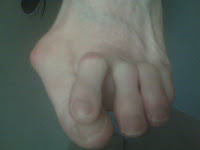
     So you or someone you love is developing a bunion, what to do? Bunions are sometimes classified Stage I (you begin to see a bump), Stage II (the toe starts to drift towards the 2nd toe), Stage III (the 1st and 2nd toes come together), and Stage IV (the 1st toe moves under the 2nd toe with great instability to the entire foot as seen in the photo above). The goal of bunion care is to keep it in Stage II. During Stage II the bunion is not getting worse quickly since its alignment with the metatarsal is not too bad relatively. Stage IV is a surgical bunion and there are many great surgeries available. These surgical corrections, however, have a 6 month to 1 year recovery period depending on what is done.

     Stage III can persist for 3 weeks or 30 years, and in general is a stable place for your overall foot stability. Once the 2nd toe begins to drift dorsally (towards the top of your shoe), Stage III can quickly become Stage IV. In Stage III, with the 1st and 2nd toes abutting, as you push off the ground at heel lift, the poor angle of the 1st toe pushes back on the metatarsal gradually increasing the bunion deformity over time.

   
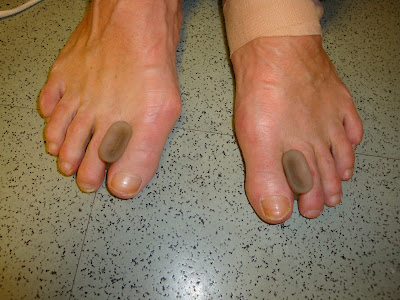
Sometimes a Budin Splint is used in Stage 4 to improve the overall stability. The success is based on the ability of the splint to keep the second toe at the same plane as the first. Here is a failure of the splint where the 2nd toe is too high off the ground.

     So the goal in treatment is to get the bunion back into Stage II---its Happy Place, and keep it there. The bunion will not go away, but you may stabilize the joint, eliminating or at least postponing surgery for a long time. Bunion surgeries have not changed dramatically in the last 30 years like knee replacements, yet, the post operative care has greatly improved. I believe that avoiding/postponing surgery now, with the chance of never needing it, is worth the possibility of better results in the future. You will see this is my bias against immediate surgical procedures.

     However, that being said, if you are disabled by anything like a bunion, try 6 months of aggressive conservative treatment first. If your condition has not improved after this time period, proceed with surgical advice. Your disability must match up with the risks and recovery period for the operation. Get 2 or 3 opinions, be a smart consumer, bring a friend or loved one to the appointments, make a logical decision, and go for it.

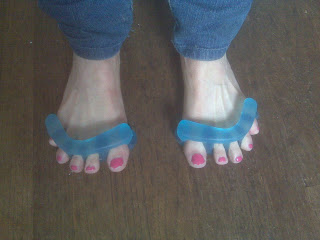
    Stage II in bunion development is where, when you stand on the ground, and look at your toes, there is still a gap or separation between the 1st and 2nd toes. Medium gel toe spreaders from Silipos® http://www.silipos.com/ or separators between those two toes instantly put the bunion in stage II. You wear them in any enclosed shoe. You can now buy socks, like Injinji ® http://www.injinji.com/ , and bedroom slippers, like Vibram ® Five Fingers http://www.vibramfivefingers.com/ , that have individual compartments for each toe to wear around the house. Several years ago, YogaPro® came out with YogaToes http://www.yogapro.com/ . The product has 5 individual compartments and patients stretch their toes for 30 minutes 2 to 7 days a week when they are sitting down. I usually start patients at 5 minutes a day several times a week and they can slowly build up time. Some patients, especially with small toes, can not wear the product at all, or it must be modified. If you are in pain, do not wear the device (Good rule of thumb for most things). YogaToes are designed only to be used while sitting. Bed, Bath, & Beyond has an effective, but not as aggressive product, called Pampered Toes®. There is another YogaToes knockoff called Healthy Toes®. Another great product is Correct Toes where you can walk around with the toes in better alignment https://correcttoes.com/

Free standing Medium Gel Toe Separators, but I also like the Zenn Toe product that fits completely over the 2nd toe

Toe separator that attaches firmly to the 2nd toe

Yoga Toes


    If your bunion is red, start massaging it. The red inflamed tissue adds to the discomfort and fragileness in shoes. Use circular motion to try to get rid of unwanted inflammation with soft tissue swelling. Gradually push harder during the massage. Massage for 5 minutes several times a day for 2 weeks longer than you think you need. What do you massage with? Ice cube is used if the bunion is sore. If not sore, use massage oil, or any hydrating, lubricating, lotion or cream. It is the massage that moves out the bad stuff.

    Padding with 1/4" adhesive felt just proximal to the bunion (called proximal padding) instantly takes pressure off of the bunion and allows you to wear many shoes that would normally irritate. The padding can be purchased in many locations including http://www.mooremedical.com/ item #09229. You normally cut out a 1 inch square and place not over the bunion, but just behind towards the arch, but as close to the bunion as possible. Best to place it on your foot directly. You can experiment with size and shapes so it does something without showing. You should never place under the foot or on the big toe itself—that will make the bunion worse. Sometimes, you may want to put on top of the 1st metatarsal and the side as just described. Each pad can be used multiple times, so 1 roll can last almost a lifetime or be shared with other bunion sufferers you know or see in the gym.

Proximal Padding is only when wearing shoes that irritates the bunion area


    Another vital aspect to bunion care is strengthening of the intrinsic foot muscles. These are tiny, yet powerful muscles within your foot that weaken over time due to life stresses (the aging process, pain, bad foot mechanics, reliance on shoes and orthotic devices, etc.) Normally, I would send a patient to a physical therapist to learn these exercises properly.

    If you can not wait, start doing the flatfooted balancing exercises now. All strengthening exercises should be done for a maximum of three days a week. Foot and ankle exercises fatigue the leg so much that they should be mainly done in the evenings when you are home for good. Stand on one foot in a doorway. Put your hands at your side so that you can grab the door frame if needed. Very slightly bend your knee that you are standing on. With your eyes open, try to balance on each foot for one minute until this is easy. Then, gradually build up to two minutes at a time. Then, begin to close your eyes during the two minutes off and on until you can keep your eyes shut the entire 2 minutes. This easy task can take 1 month to 1 year to complete. The longer it takes, the more important it is for you to accomplish this tremendous strengthening exercise. Very important: do not push through any pain whether it is in your foot, ankle, knee, hip or back. This is really where a physical therapist can help making sure you are safe at what you are doing. You can always have a doctor write a prescription and send you to therapy for 4 sessions to learn a HEP (Home Exercise Program).

     In summary, bunion care should be started as soon as possible after making the diagnosis. Elements of treatment should include toe separators/spreaders, YogaToes or a knockoff version, proximal padding, possible socks and slippers with individual compartments, foot strengthening and massage. . Hope this was helpful. Of course, most of this advice is also used post-operatively to stabilize the strengthen the foot if it ever gets to that point.

Key Word: Bunion