Total Pageviews

Translate

Followers

Monday, December 19, 2022

Posterior Tibial Tendon Injuries: Conservative Management

https://pubmed.ncbi.nlm.nih.gov/22938638/

Whereas there are too many articles implying surgery even in Stage 1 Posterior Tibial Tendon injuries, I hope this blog post will help direct you into more conservative management first. 

The following is an excerpt from Chapter 13 of "Secrets to Keep Moving" on Posterior Tibial Tendon Problems. It is an important tendon to protect. Yet, surgery in Stages 1, 2, and 3 can still be delayed or prevented if the doctors skill level can increase in conservative treatments. At least, you can have better informed conversations with your doctor after reading this. 

7. Posterior Tibial Tendinitis/Dysfunction/Tear

    The posterior tibial tendon is the major tendon to support the main arch of your foot. Damage to the tendon causes arch collapse to a major degree. Any sign that this tendon is have problems must therefore be over treated to avoid long term issues. It is one of the most common surgeries on my patients because of the disability. I work long and hard on each one of these patients both trying to avoid surgery (usually), or post surgical rehabilitation.    

https://youtube.com/watch?v=YPyC0ze2gO4&feature=shares

The top 10 treatments for tibial tendinitis/dysfunction/tear are:

1.  Understand the biomechanics of the posterior tibial tendon to support the medial longitudinal arch and begin to support the arch as part of all phases of the rehabilitation: Immobilization, Re-Strengthening, and Return to Activity.

https://youtube.com/watch?v=7ilOVqF0aPc&feature=shares

2.  Start with OTC and advance to custom orthotic devices with maximal support (this is not an injury to have less than optimal support).

3.  Learn several different taping techniques: posterior tibial and circumferential arch.

https://youtube.com/watch?v=AcSSyBfFocE&feature=shares

4.  Ice the area 3 times daily for 15 minutes each.

5.  If possible, get a baseline MRI (may be an important comparison 6 months later), or baseline ultrasound imaging.

6.  Most ankle braces hold the ankle pronated which is bad for this injury, consider an Aircast Airlift PTTD brace for times you are not using orthotic devices.

7.  Create an initial pain free environment with below knee removable boot/cam walker, and perhaps a Roll aBout knee scooter.

8.  If the injury is substantial (Grade 3-4 typically), have a rigid AFO custom made at a brace shop right at the start of the injury (it can take awhile to get fitted)

9.  Begin strengthening the posterior tibial tendon as quickly as possible with at least active range of motion exercises. The Posterior Tibial tendon is strengthened by pointing the ankle first and then moving the foot towards the other foot. See Chapters 2 (general strengthening principles) and 6 (tendinitis principles).

https://youtube.com/watch?v=w3FXx4OFqec&feature=shares

10. Definitely have a surgeon as part of the treatment, or the help of a regenerative specialist.

Email Correspondence 

Patient: Hey Doc!!

I found your blog and I am so grateful! I have already learned a great deal. I really need your advice and help. Last fall I started to play tennis again. I played daily and began to have foot pain.

Dr Blake's comment: When have taken time off from exercise, it is important to start every other day so that you can access the toll on your body correctly, and give yourself the 48 hours to regain your strength in your muscles. 

Patient: The inside of my ankle and the bottom of my foot were sore. In November I saw the ortho and he said I had PTTD.
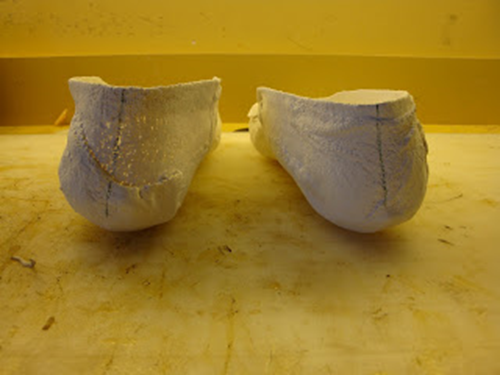

Impression Casts taken of a left sided PTTD showing the collapse inward of the heel and arch more than the right.

Dr. Blake's comment: Posterior Tibial Tendon Dysfunction diagnosis can be like shin splints, you really do not know what is wrong by the name. The Posterior Tibial Tendon is the most important tendon to support your arch. The Dysfunction part implies that the tendon is not doing it's job, and patients have seen complete collapses of the arch in severe cases requiring surgery. Since I do not know the severity, but Melanie is implying that it seems difficult to treat, therefore, to protect her, some immobilization must be recommended until more info is obtained.
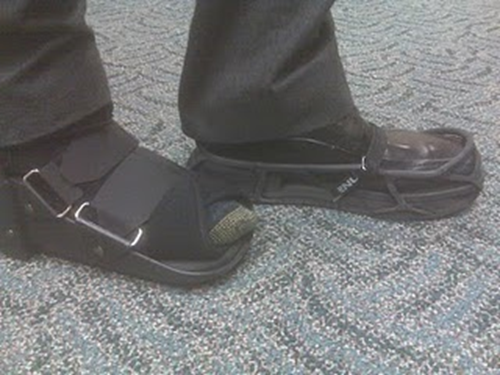


Patient:  He put me in a walking boot and that did not help.

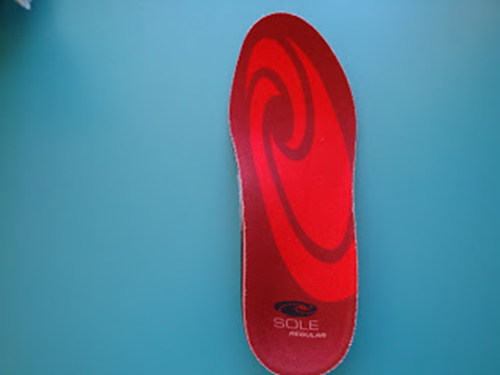
Dr. Blake's comment: This requires further information Melanie. The boot, like the photo above, should have calmed the tendon down. Did  it hurt just as much, 50% as much, hard to tell? There are so many factors that come into play with your injury. Normally, the below the knee boots are better than the mid calf or ankle high ones. They distribute the force of stability over a larger area. Also, with PTTD, normally wearing an arch support in the boot is crucial. If you do not have a comfortable custom one, get the heat moldable Sole supports soft athletic version. These are sold at sporting good chains like DIck's, REI, etc. 


Patient: He also told me that I have an accessory navicular bone. 
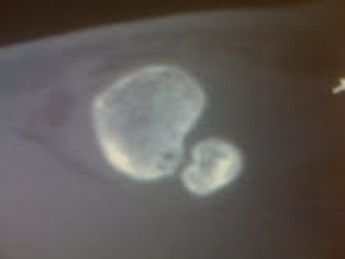

This CT Scan shows an Accessory Navicular, aka Extra Ankle Bone, aka Os Tibial Externum. Typically starts forming around 9 years old, and completely formed by 16. It can begin to give problems in young children in their early teens, or later in life. 

This extra bone occurs in a small percentage of people and normally weakens the attachment of the posterior tibial tendon into the arch making it less effective in supporting the arch and stabilizing the inside of the foot and ankle. 


Patient: It seemed to get worse. ( no arch or foot support in the boot). So  off I went to the podiatrist. He gave me an a shoe insert. It didn't help.

Dr Blake's comment: One of the very crucial points I need to make to all orthotic wearers is why are you wearing them, and are they successfully fulfilling the purpose they were prescribed? Why did you get the orthotics? Pain relief, or better function? Orthotics if done well should make the posterior tibial tendon work better, but maybe, just maybe, you are in the Immobilization Phase of Rehabilitation, not the Re-strengthening Phase. So, a great orthotic device for PTTD can make you hurt a lot more just because it is being used to stabilize and re-strengthen at a time you should be immobilizing and using anti-inflammatory methods. You are definitely in the removable boot with some sort of orthotic and arch taping period.
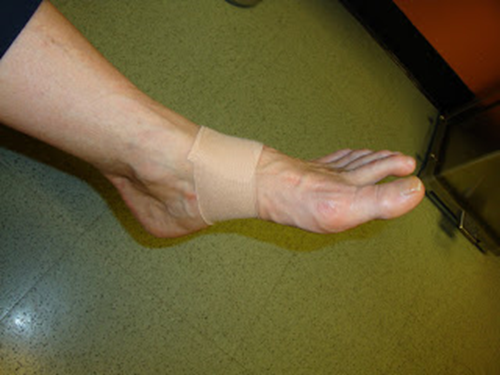

Kinesiotape used for Circumferential Arch Immobilization


Patient:  About a month ago, I slipped in the kitchen and twisted the ankle on the same foot with the PTTD. Since the initial fall I have rolled it two more times!

Dr Blake's comment: Once you hurt a major tendon, you body naturally protects itself. You can roll your foot to the outside which makes you more prone to sprains, or if a step will produce pain, you can just let the foot collapse/shut off and you fall to the ground. These scenarios are quite common. And, if they are happening to you, I can see why you emailed. It is very very frustrating.

Patient:  I look like someone beat me up!  I keep spending money on shoes, inserts and I need some advice.  I started the tennis to lose weight, and I was.  Do I need a PTTD brace?  I purchased some Orthaheel shoes but my foot for some reason gets to a weird angle in them. I am doing the exercise you recommend for strengthening my ankles. I know losing weight will help me, but I need to know what to do so I can get back to tennis!

Thank you so much!!

Melanie (name changed due to witness protection)

Dr. Blake's response: 

Dear Melanie,

    Thank you very much for writing. I hope some of my initial comments were helpful. Please feel free to comment on this post and I will try to respond in a timely fashion. To summarize:

#1     You are probably in Phase 1 of Rehabilitation: Immobilization and Anti-Inflammatory where you try to create a Pain Free Environment to let the tissue heal.  We need to get you to that 0-2 pain level range for 2 weeks straight.

#2     You can try combining the boot and orthotic, but may have to get another boot or a different orthotic. You need to put out the time and effort in creating this pain free environment.

#3     You should consider crutches, and even a Knee Scooter, for a short time, if that is what it takes.

#4     For the Anti-Inflammatory part, definitely start ice packing for 10 minutes three times daily. The ice pack can be placed in the boot and you walk around (multi-task). Consider anti-inflammatory meds, flector patches, and physical therapy for anti-inflammatory only (although you can send me a video of you bouncing on the trampoline). LOL

#5     Normally, if the accessory navicular is the source of pain, the pain will localize there as the symptoms die down.

#6     You should get (if possible) a baseline MRI or Ultrasound of the ankle. It will show the rearfoot also, and may give clues to what is broken. Hopefully, you strained but not tore the tendon.

#7    Since tennis is out of the question right now, consider elliptical or stationary bike, even some pool workouts will not irritate, as long as whatever you do does not irritate the tendon.

#8     One important bit of information I need to further advise regards pain. What produces it? How is it in the morning? See if you can write up and email the pain questionnaire from Chapter 3. Also, go through the various foot and ankle exercises described in my blog, at least the ones not requiring equipment, and tell me which ones are painful and which ones are symptom free. Go to YouTube and type drblakeshealingsole foot and ankle strengthening playlist.

 Further Email Correspondences


Dear Yvonne, Thanks for the email. I hope the video (go to YouTube and type drblakeshealingsole posterior tibial strengthening exercises) helps you understand the 4 basic forms of strengthening exercises used in the treatment of posterior tibial tendon dysfunction. Gradually the patient is progressed from Active Range of Motion to Isometric to Progressive Resistance to Functional. Heat (in the form of warm water soaks, heat liniments, or heating pads) is used often to loosen up the tendon before exercise for 10 minutes. If walking is not painful, 5 minutes of walking can get the blood pumping. Ice should be used after for 10 minutes, normally an ice pack over the sore area. NO Pain can be experienced during the exercise. If you are still having trouble strengthening without pain, try the numbing effects of ice. Ice the area for 5 minutes, then let the tissue unthaw for 20 minutes, and then try the exercise. Should work unless the tendon is significantly damaged. Then ice 10 minutes afterwards. I sure hope this helps.

Rich

Further Email Answer

Patient: Dear Dr. Blake,

I have searched your informative blog after not finding much on PTTD. I really enjoyed reading your tailored approach to each patient in your blog comments, and I am hoping you can give me some useful insights. I do like and trust my podiatrist, but I am in a quandary and want to explore every avenue before entering into surgery.

Dr. Blake's comment: PTTD stands for Posterior Tibial Tendon Dysfunction. This is the most important tendon for supporting the arch. Complete tearing of that tendon always leads to complete arch collapse. So this is a very serious problem.

Patient: I am a 40 year woman in excellent shape, trying to avoid surgery for PTTD.  I found you in reference to your use of inverted orthoses and I am wondering if the consistent use of them might help me. I have consulted with two podiatrists and both have agreed on the PTTD diagnosis, now I just need to figure out my plan.

Dr. Blake's comment: The Inverted Orthotic Technique is the most sophisticated foot orthotic for arch support and is always used for PTTD. There are only a handful of orthotic labs in the US that make them, but a relatively easy technique to learn. Many labs now have versions of varus or inverted methods that can help greatly like the Mueller PTTD orthotic device. Before you try to find a lab with the Inverted, have the lab make the best possible orthotic device that they make for PTTD. Posterior tibial tendon acts across the foot and the ankle. A foot orthotic will help the foot component, but at times, the ankle also must be initially immobilized. In that case, you need a rigid AFO.

Patient: History and background:

I sprained both ankles in my early 20's, the left ankle was a more severe sprain.

Dr. Blake's Comment: this probably left her with some weakness in her arch.

 Patient: I have had pain in the arch ankle area of my feet for the past six or seven years, always when wearing improper footwear (heels). The pain always stopped when I went back to supportive/comfortable shoes.

Dr. Blake's Comment: this is the classic presentation of PTTD where the symptoms begin gradually in the arch and/or ankle areas.

Patient: I work-out in the gym four times a week (weights, elliptical, stair climbing machine) and have always hiked for exercise (usually once a week). My problem became severe when, on a two-week trip in SE Asia in the Nov. '09, I wore flip-flops almost exclusively. We did tons of walking, and at for the first time I noticed my feet burning and tingling in the evenings. I did not connect this sensation to my other painful flare-ups, because I had always assumed it was my high heels causing it. It did not occur to me that I could hurt my feet wearing flip-flops.

Dr. Blake's comment: Again, the symptoms of PTTD gradually begin to change affecting other activities, although one day of aggressive walking in flip-flops if you have a predisposition can cause symptoms.

Patient: Over the next six months I experienced increasing pain in both feet upon getting out of bed and standing up first thing in the morning. My left ankle and arch started to look slightly swollen, but I did not see a doctor.

Dr. Blake's comment: This is probably the first mistake, if you see swelling, the body is actively trying to heal something, and may need some help and guidance.

Patient: I finally sought treatment when, after a run last summer (August '10) , I was in so much pain in both feet that I had trouble walking. I experienced shooting pains up the calves up both legs at night and my left ankle and arch was red and painfully swollen.

Dr. Blake's comment: Here she is in the Immobilization/Anti-inflammatory Phase of Rehabilitation. You must create a pain-free environment and allow the tendon time to heal. You normally need a removable boot, followed by brace or AFO, followed by orthotic device. You normally need to combine immobilization with ice and contrast bathing to reduce swelling in the tendon. You normally begin strengthening the tendon pain-free from the first visit. Emphasis on the pain-free.

https://youtube.com/watch?v=rRt5hC24Afg&feature=shares

Patient: First podiatrist diagnosed stage 1 PTTD and prescribed orthotics. Second podiatrist concurred and added ice/anti-inflammatory therapy and in addition put me in a walking boot until my inflammation subsided. After six weeks in boot I went to just wearing the orthotics and sometimes Dansko shoes. My right foot felt 98% better, and my left foot was improved to the point where I could often walk with no pain (always wearing orthotics).

Dr. Blake's comment: Stage 1 the tendon is inflamed, but fully functional. Stage 2 the tendon has some tearing, and begins to not support the arch well. Stage 3 the tendon tears enough to not be functional, and the arch begins to collapse. Stage 4 the tendon completely tears and the arch completely collapses

Patient: Which brings me to my present situation; I am in pain a lot of the time once again, as sometimes want to be barefoot (live at the beach, have a six-year old daughter), wear an attractive (flat) sandal with support, but find that I cannot do so without incurring a lot of pain in my left foot. As I write this I am back in my walking boot as left inside ankle/heel area is throbbing with a dull pain. I wore shoes without orthotic devices yesterday and I'm now paying the price!

Dr. Blake's comment: Golden Rule of Foot: Create a Pain-free Environment or else the problem will not heal. This is especially true with PTTD. You need to create a pain-free environment. You must stay in that boot until the pain goes away, and then add another 2 weeks for good measure. I think one of the big treatments you have not mentioned is progressive posterior tibial strengthening. We need to make you strong!! 

Patient: Upon hearing all of this from me, my podiatrist has finally recommended surgery. He is of the opinion that that is the only solution for my particular situation. I tend to agree, but I feel overwhelmed when I hear the reality of the recovery. Is there any chance he is wrong? Could I religiously wear the inverted orthoses and "heal" my left foot the way my right foot was improved? Or should I just "suck it up" and do the surgery so I can have a chance for a real recovery and a lifestyle that will resemble "normal" again?

Dr. Blake's Comment: yes, yes, maybe

And Further Response to same patient: 

            Thanks for the email. When patients present to my office with this scenario, I just try to start over. Pretend the injury just happened. Try to put a healing environment together for them to hopefully end with a successful rehabilitation. Sometimes the decisions are hard to make, but we make them and stand by them.

            So, what must you do now? What will allow you to heal? First of all, surgery is only needed at times for Stage 3 and 4. Does not sound like you are there. Your focus must be immobilization, anti-inflammatory, and re-strengthening. Nothing from this point on should hurt. The activities should not hurt, the strengthening exercises should not hurt, and the physical therapy should not hurt. Definitely read Chapter 2 on Good vs Bad Pain and live by it.

            Since the posterior tibial is the strongest arch support tendon, help it out as much as you can to do it's job. This is accomplished with taping techniques, the Inverted Orthotic or similar protective orthotic device offered by labs, stable shoes, wedging of shoes, power lacing, and bracing. Your podiatrist/therapist and you need to create a stable environment, whether it is pre or post surgery. So if a surgeon does not know how to create a stable environment for your tendon, if he/she does surgery, they most likely will not know how to rehab it after.

Here are so many strengthening exercises for the posterior tibial tendon that it is normally easy to gradually build up the strength. Remember, if you try to strengthen a muscle/tendon, and you produce a pain response, the tendon in the end gets weaker. Since the posterior tibial tendon is next to the posterior tibial nerve, there may be some 0-2 pain that the therapist feels is acceptable, but it should have no increased pain afterwards. 

https://www.drblakeshealingsole.com/2010/06/quick-tip-9-begin-strengthening.html

            What helps control inflammation? Icing (if there is no swelling or just after activity), contrast bathing if there is swelling, physical therapy, acupuncture, many topical creams (some by Rx and some OTC), and oral medications. I like to stay away from months and months of oral medications, but short courses when the inflammation is flared is fine.

 So Joann, my recommendations for you right now:

  1. Stay in the Removable boot for the left side until you can walk without pain for 2 weeks.
  2. Purchase an Even-up for the right side to protect your back.
  3. Begin icing 3 times daily for 10 minutes both sides. The left should have evening contrast baths starting at one minute hot and one minute cold alternating for 20 minutes due to the throbbing.
  4. Get an Inverted Orthotic Device for both sides, or similar PTTD device per the podiatry lab, which is some type of orthotic that does not allow your foot to pronate at all. You will need this to gradually wean off the cast.
  5. Begin some posterior tibial tendon strengthening each evening followed by 10 minute ice bath.
  6. Get bilateral ankle MRI’s to document June 2011 status of both your tendons.
  7. Find out the stage of your posterior tibial tendon disease. 

I sure hope this helps.

Rich


Sunday, December 18, 2022

Answers to Friday's Sports Medicine Quiz

Sports Medicine Quiz: Answers for Sunday 12/18/22


Sports Medicine Quiz
Dr Rich Blake
CSPM at Samuel Merritt University
 
 
1.    Strain is to muscles as sprain is to ______Ligaments_____________.
2.    What are 4 general principles of stretching?
·          Should never be painful
·          Slow count to 30 with each step of 5 deep breaths
·          No Jerking (called Ballistic Stretching)
·          Most benefit from Stretching is after you workout or warm up the tissue
3.    What is the mnemonic for treatment of tendon injuries?
 BRISS (Biomechanical factors, Rest or Activity modification, Ice or anti-inflammatory, stretch and strengthen
4.    What are the 3 phases of Injury Rehabilitation?
 
·         Immobilization Phase 
·          Re-Strengthening Phase
·          Return To Activity Phase
5.    What are 2 types of AROM strengthening exercises?
·           Short Arc AROM
·          Full Range AROM
6.    What are the 3 types of pain that we deal with in sports medicine?
·          Mechanical Pain
·          Inflammatory Pain
·          Neuropathic Pain
7.    What nerve root can give symptoms in the big toe? ____L3L4______
8.    If you are 80% better, what is your activity level? ______Back to All Your Previous Activities_____
9.    What is the most common cause of plantar fasciitis? _____Over Stretch of the Plantar Fascia____
10. Explain “Weakest Link in the Chain” concept for excessive pronation and medial knee pain.
 When we over pronate, the internal rotation of the foot holds the knee internally rotated while the
pelvis and hip are externally rotating. This over pronation affects the weakest link in the lower extremity causing pain up
and down the chain. In the case of medial knee pain this abnormal internal tibial position causes the vastus medialis to be over
stretched, weakening it, and allowing the patella to sublux laterally. The pain can be from the medial compartment of the
patellofemoral joint or just a strain of the medial knee structures.  
11. What are 5 mechanical causes of overuse injuries? 
  • Over Pronation  
  • Over Supination
  • Limb Length Discrepancy
  • Poor Shock Absorption
  • Weak and Tight Muscles   
23. What does a “dancer’s pad” do?
 Off weight the first metatarsal head
 
24. What are 3 components of an Ideal Running Form?
·          Slight Forward Lean of the Body
·          Foot Strike Just In Front of the Belly Button
·          Smooth Roll Through Foot into Push Off
25. If you have metatarsalgia, would you want a zero drop shoe or a standard motion control shoe? ________Zero Drop______
26. What are the 2 changes in your stride that allow you to run faster?
·          Increased Stride Length
·          Increased Stride Rate
27. Is the Hoka One One shoe line considered a minimalist shoe?  _____No_____
28. What type of heel injury can you imagine in a runner overstriding with heel strike and minimalist shoes? _____Heel Bruising or Plantar Heel Bursitis_____
29. Can walkers achieve the same health benefits with less injuries than a runner? ___Yes, just takes 4 times longer for exercise___
30. How does where a runner strikes the ground influence treatment (compare heel strike to forefoot strike only)?
 The stability of the shoe or orthosis must influence foot strike position the most. Therefore, forefoot strikers need more support in the forefoot of the shoe and orthosis than a rearfoot striker who needs the support further back.
31. A 45 year old with repeated running related stress fractures should have the following tests:
 
·          Vitamin D Blood Level
·          Bone Density Test

Thursday, December 15, 2022

Sports Medicine Quiz: Answers on Sunday 12/18/22


Sports Medicine Quiz

Dr Rich Blake

CSPM at Samuel Merritt University


1.    Strain is to muscles as sprain is to ___________________.

2.    What are 4 general principles of stretching?

·          

·          

·          

·          

3.    What is the mnemonic for treatment of tendon injuries?


4.    What are the 3 phases of Injury Rehabilitation?


·          

·          

·          

5.    What are 2 types of AROM strengthening exercises?

·           

·          

6.    What are the 3 types of pain that we deal with in sports medicine?

·          

·          

·          

7.    What nerve root can give symptoms in the big toe? __________

8.    If you are 80% better, what is your activity level? ____________

9.    What is the most common cause of plantar fasciitis? _________

10. Explain “Weakest Link in the Chain” concept for excessive pronation and medial knee pain.


11. What are 5 mechanical causes of overuse injuries?

·          

·            

23. What does a “dancer’s pad” do?


24. What are 3 components of an Ideal Running Form?

·          

·          

·          

25. If you have metatarsalgia, would you want a zero drop shoe or a standard motion control shoe? ______________

26. What are the 2 changes in your stride that allow you to run faster?

·          

·          

27. Is the Hoka One One shoe line considered a minimalist shoe?  __________

28. What type of heel injury can you imagine in a runner overstriding with heel strike and minimalist shoes? __________

29. Can walkers achieve the same health benefits with less injuries than a runner? ______

30. How does where a runner strikes the ground influence treatment (compare heel strike to forefoot strike only)?


31. A 45 year old with repeated running related stress fractures should have the following tests:


·          

·          


Monday, December 12, 2022

Secrets to Keep Moving: A Guide from a Podiatrist

I would love to plug my 2016 ebook called Secrets to Keep Moving: A Guide from a Podiatrist. The link is to the right of this image for purchasing. I will be releasing the 2nd Edition next year in both book and ebook formats a little more price friendly. Rich 

Book image not available.


https://store.bookbaby.com/book/Secrets-to-Keep-Moving-A-Guide-from-a-Podiatrist

Saturday, December 10, 2022

Sesamoid Injury in a Young Athlete: Email Advice

Dear Dr. Blake,

Thank you for your many videos and resources!

My son suffered a tibial sesamoid stress fracture on 9/27 and was initially on crutches for two weeks and has since been in a boot. He has a bipartate tibial sesamoid that mri revealed is in fragments and suspected AVN. We had a consult with his doctor on Tuesday and he recommended tibial sesmoidectomy. My son is still suffering from intermittent swelling/discomfort. I have him taking vitamin D with K, Calcium/Magnesium and naproxen. He has been icing and elevating, but at time overexerts his foot (his football season was cut short and now he’s sitting the bench for basketball). He is ready to feel better and wants to have surgery.

In your opinion, with the fragments, AVN and continued swelling/pain, should we proceed with the surgery? We were informed this could be chronic and it’s better just to have it removed now while he’s young and not in high school sports yet. 

Dr. Blake's comment: Thanks for the email and MRI report. I am never convinced that there can be AVN within the first 2 months of an injury. Your son developed a terrible injury with bone swelling in 3 separate areas. It would be so hard to recommend surgery on the tibial sesamoid when there are other areas that could be the primary cause of his problem. I am happy to look at the MRI if you want to send it. I think a second MRI really should be done 6 months after the first to see what is changing. No fracture is seen, so there is no reason to believe he can not heal just fine. An injury to a spot you walk on is always going to take the longest to rehabilitate. If the doctor is worried about bone healing, besides the wonderful attention paid to bone health, we need to get the Exogen bone stimulator and contrast bathing daily. I was in high school, and also missed a year with an injury. It was no fun, many tears, but I played college sports. If he loves sports, he will recover. Rich 

Healing from Sesamoid Injury: Email Advice

Hi Dr Blake ,

Your blog and email advice helped me tremendously in the last few years dealing with severe sesamoid problems (AVN and sesamoid displacement). It's been a long road, but having followed your protocol I am able to do most things today and avoid surgery.

I am getting back into tennis (after 3 years without playing!!) and so far have been playing in Hokas to protect my sesamoid. However, Hokas are not particularly recommended for tennis - I believe they don't provide good stability for lateral movements and are a bit high so increase the risk of rolling an ankle. Do you have a recommendation for a good tennis shoe that could still provide cushioning to the sesamoid?

Many thanks and happy holiday season,

Dr Blake's comment: 
     I am so happy that your sesamoid issue is resolving. But it is motivational for others who develop AVN and/or some sesamoid fracture displacement. My quick answer is wear good ankle braces for your tennis. I love the ASO brace. It is my go-to. My second answer would be a slow gradual introduction to well padded tennis shoes with your orthotic devices, and perhaps added dancer's pads on top of the orthotic while playing only (Dr Jill's gel dancer's padding), and spica taping and cluffy wedge to your foot. Limit your initial introductory time to 30 minutes, and ice after. Let me know after you have done 5 workouts. Good luck. Rich 

Thursday, December 8, 2022

Sesamoid Injury: Email Advice

Dr. Blake -

     On October 24th I was doing a tempo run as part of my half marathon training when I noticed my left foot hurting (on top) I took a week off and thought it to heal but it still hurt. I went to get an x-ray which revealed a clear break in my sesamoid bone.

Dr. Blake's comment: The sesamoid fracture should give you only pain when it first presents under the big toe joint.  I am assuming the examination showed pain under the sesamoids. 

     They gave me a CAM boot and said wear for 6 weeks and scheduled an mri to confirm it. 3 weeks after I got the boot I had the mri which confirmed the break. They said they want me in s boot for 12 weeks.

Dr. Blake's comment: So far, the advice is sound. The boot should be worn with an EvenUp on the other side. If there is pain in the boot over 0-2, you have to wear off weight bearing padding to shift the weight lateral. Also, this is the time to cross train with stationary bike, swimming, etc (just no impact). Also, winter stress fractures always have me concerned about Vitamin D deficiencies, so please have it checked.  

     I am on week 6 and it seems to hurt worse than it did at first. I am an avid runner and exerciser and I feel like I am losing my mind. They mentioned most likely me having to have my sesamoid removed. I want to try anything to avoid this. I am current in a post op hard soled shoe and want to know if I am doing everything I can to heal in the next 8 weeks. ANy advise would be greatly appreciated. I can pay you and can send over my x ray if needed.

Regards,

Dr. Blake's comment: Yes, you can send xrays and MRI to Dr.Richard Blake, 900 Hyde Street, San Francisco, California, 94109. Why are you not in a CAM walker now? Have they designed off weighting orthotic devices for you which can be worn in the boot? Boots can cut off the circulation, and sometimes patients wear too much (only need for walking). Is there alot of swelling, which can give you pain? Send a photo to the rlb756@gmail.com of the top and bottom of your foot. You can see if contrast bathing, usually very helpful, soothes the foot. Start with one minute hot and one minute cold water and rotate up to 20 minutes each evening. No surgery considerations until after you have had 9 months of Exogen bone stimulator for a non healing fracture. Typically repeat MRI at the 6 month interval, although 3-6 months are considered okay. I like to wait as long as I can, but sometimes we need to know sooner. Hope this helps. You have create that constant 0-2 pain level if you are going to predictably heal well. 

Patient answered:

Thank you so much!!! I can’t find anyone in my area that seems to be experienced with this break. They all say surgery most likely. The CAM boot hurt other areas of my foot and my opposite hip. It’s so heavy, I haven’t been fitted for orthotics as I’m not even sure where to start. I don’t really have much swelling and it looks a little bruised on the top of the ball of my big toe. I’ll send my records to you. I will also post this on your site.

Dr Blake's response: Try this local Podiatrist who is a member of our national sports academy, the AAPSM. 

David E. Linde, DPM205-445-0661One Independence Plz. #530BirminghamAL35209
Also, try bike shoes with embedded cleats instead of the boot to immobilize. 

Wednesday, December 7, 2022

Sesamoid Injury: Email Advice

Hi Dr. Blake,

I have been managing my sesamoiditis since August, from an injury sustained 
in April due to 10k training. Initially diagnosed as arthritis until I saw 
a podiatrist in August who diagnosed sesamoiditis after x ray. By October I 
was in a boot without orthotic and improving, but unfortunately my 
podiatrist encouraged me to get out of the boot and go back to normal shoes 
with tape without a wean out period, and pain returned by Thanksgiving to a 
5-7 pain scale. I discovered your blog at the end of November, and have 
been doing boot (used felt to offload sesamoid) constantly, contrast baths 
BID, icing BID, and had some custom orthotics made to offload the sesamoid.

I decided to get a second opinion from an orthopedist, who took some x rays 
and found no fractures in my sesamoid itself, but that I had a stress 
fracture in the middle part of my navicular bone of my foot. He assures me 
this is unrelated to my sesamoiditis. The navicular area itself doesn't 
hurt. I wanted to see if you have ever heard of a navicular stress fracture 
causing sesamoid problems. I'm currently maintaining a 2-4 pain at my 
sesamoids and am hoping to start transitioning into shoes with orthotics 
next week when my pain is at a 0-2.

Any perspective you can offer would be valued.

John (name changed)

Dr Blake's comment: John, thanks for reaching out. There is no obvious connection, and the navicular diagnosis is suspect due the lack of pain in that area. Sounds like you are doing well. Make sure you experiment with cluffy wedges and spica taping as you attempt to leave the boot behind. I also recommend Hoka shoes for their rocker platform at least as a part time shoe. Rich 

Tuesday, December 6, 2022

Comparing Child's Shoe Sizes to Women's Shoe Sizes

https://www.hibbett.com/expert-advice/how-to-convert-womens-to-kids-shoe-sizing.html

Dr. Rue Tikker demonstrating Foot Manipulations

https://youtu.be/TYMdab8ITi4

     Dr Rue Tikker practiced Foot Manipulation. He taught his Podiatry Partner Dr. Timothy Shea, who then taught Podiatry Students at the California College of Podiatric Medicine. I use some of these manipulations (called Grade 5 Mobilization) in my practice 40 years later. I thank Dr. Eddie Davis for finding this old video. 

More about Dr Timothy Shea

Monday, December 5, 2022

Heel Raises: So Important for Seniors and Overall Health

https://youtu.be/0r6w8K6ckQk

     This video highlights one of the two most important exercises in the lower extremity and is well done. The end of the video discusses negative heel positions and this is where I would differ as I prefer to have my patients stay away from negative heel positions. However, the logical progression to this video of gradually adding more difficulty is wonderful. The goal standard in sports medicine is 25 single leg heel raises, and the video shows you how to get there. The video also does not delve into the complexity of separating the gastrocnemius and soleus muscles, but again it is a great starting place. You want to gradually, probably on a weekly basis, add 2 more repetitions from her starting point of 1 set of 5 repetitions. Work your way through two sided heel raises, to two sided up and one down, to single sided (one up and down). Have fun getting your achilles tendons stronger.